
📙論文名稱:
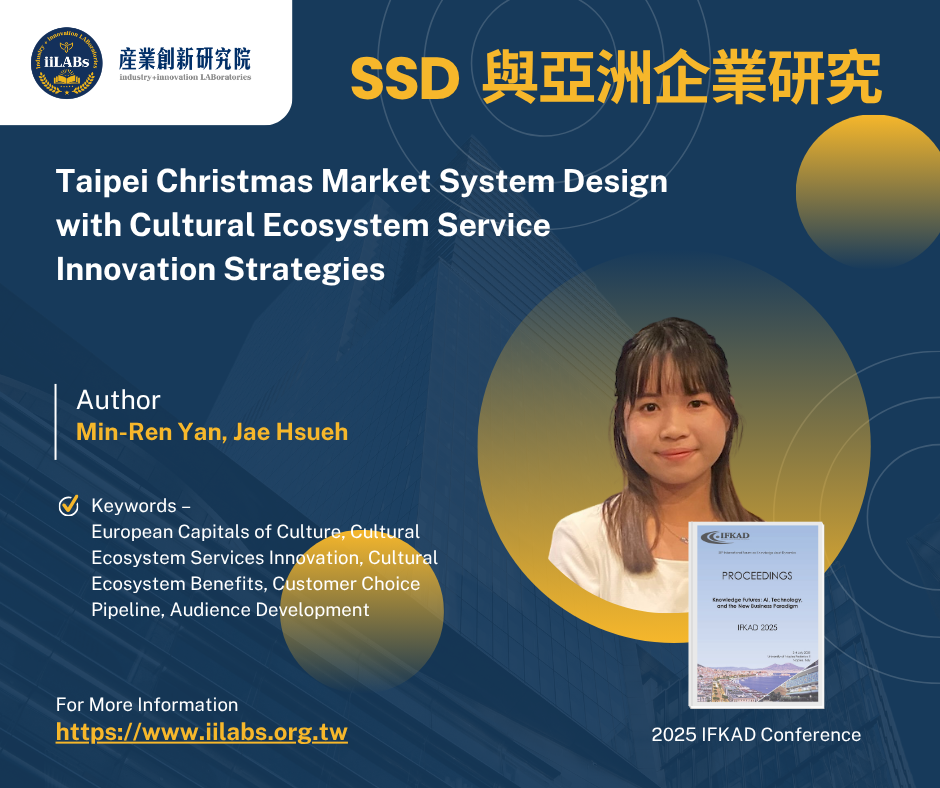
Taipei Christmas Market System Design with Cultural Ecosystem Service Innovation Strategies
📙刊登處:2025 IFKAD國際學術研討會
📙作者姓名: Min-Ren Yan, Jae Hsueh
論文摘要:
Urban development in the 21st century has evolved beyond the traditional focus on infrastructure and economic expansion, shifting toward a more integrated approach that emphasizes sustainability, cultural heritage, and public engagement. Many cities around the world are leveraging cultural events and the revitalization of historical assets to enhance urban resilience and foster stronger community connections. Within this context, the concept of the Eco-Museum has gained prominence as a means of integrating cultural assets into urban environments. Unlike conventional museums, an Eco-Museum treats the entire city as a dynamic cultural space, incorporating public participation and sustainability as core principles. The Taipei City Government has actively embraced this concept through the Taipei Eco-Museum Project, an initiative that transforms urban spaces into curated cultural experiences by linking historical landmarks, local traditions, and contemporary urban life. As part of this broader framework, this study explores how the Taipei German Christmas Market can be reimagined as a cultural ecosystem service that not only enhances the festival’s appeal but also strengthens the city’s identity, livability, and international visibility.
Drawing inspiration from the success of European Christmas markets, particularly those in Germany, this research recognizes that such markets extend far beyond being seasonal attractions. Rather than serving purely commercial or entertainment-driven purposes, these markets are deeply embedded in cultural heritage, educational engagement, and local community participation. The Nuremberg Christkindlesmarkt, one of the oldest and most iconic Christmas markets, illustrates this well through its rich historical traditions, religious symbolism, and strong emphasis on sustainability. The annual opening ceremony, featuring the figure of the Christkind, conveys messages of peace, unity, and cultural heritage, reinforcing the market’s deeper cultural meaning. In addition, the Nuremberg market actively incorporates sustainable practices such as the use of reusable tableware, prioritization of local agricultural supply chains, and adoption of renewable energy sources. These elements demonstrate how Christmas markets can serve as cultural platforms that balance economic, environmental, and social objectives.
While Taipei’s German Christmas Market has successfully introduced the European festive atmosphere to local audiences, its primary focus remains on commercial and entertainment aspects, leaving significant gaps in cultural education, historical storytelling, and interactive engagement. Unlike its European counterparts, which prioritize immersive learning experiences and active cultural participation, Taipei’s market largely positions visitors as passive consumers rather than as engaged cultural participants. This study, therefore, seeks to explore how the Taipei German Christmas Market can transition from being a commercialized seasonal event into a cultural institution embedded within the city’s urban fabric, aligning with the principles of the Eco-Museum concept.
To achieve this transformation, this research adopts the Cultural Ecosystem Service Innovation (CESI) framework, a strategic model that integrates cultural, environmental, and social values into event planning. By applying CESI principles, the study proposes a holistic approach to event design that not only enhances the festival’s aesthetic appeal but also maximizes its educational, social, and economic benefits. Additionally, the research incorporates methodologies from the European Capitals of Culture (ECoC) initiative and the European Commission’s Audience Development Study, which emphasize place-making, digital engagement, capacity-building, and participatory co-creation. These frameworks provide essential guidelines for structuring the market in a way that fosters deeper engagement with cultural heritage, encourages public participation, and promotes sustainability.
In order to ensure the long-term success and audience engagement of the Taipei German Christmas Market, this study also employs the Customer Choice Pipeline model, a phased strategic framework that maps the progression of visitors from initial awareness to sustained participation and long-term loyalty. Under this model, the proposed enhancements to the market include cultural education elements, such as guided storytelling experiences and interactive workshops, which allow visitors to engage with the history and traditions of German Christmas markets. Sustainability initiatives, including the implementation of reusable materials, collaboration with local farmers, and the integration of green energy solutions, reinforce the market’s commitment to environmental responsibility. Furthermore, innovative promotional strategies leveraging digital tools, augmented reality (AR) tours, and social media engagement aim to expand the market’s reach while enhancing the visitor experience. The study also advocates for a community-driven approach, in which workshops, local artisan showcases, and cross-cultural collaborations contribute to a more inclusive and participatory event.
By implementing this multi-dimensional strategy, the Taipei German Christmas Market has the potential to evolve into a meaningful and culturally significant event that transcends its commercial function, fostering a stronger sense of place and deepening the connection between residents, visitors, and the city’s international identity. This research ultimately seeks to provide a systematic, scalable, and locally adapted blueprint for integrating cultural sustainability into urban event planning. Beyond its application to Christmas markets, the study offers insights into how cultural initiatives in Taiwan and other regions can harness the Eco-Museum framework to develop more immersive, sustainable, and socially engaged public events.
In conclusion, this study underscores the importance of reframing cultural events as holistic, multi-layered experiences that contribute to urban sustainability and public participation. In this light, the Taipei German Christmas Market should not merely be an entertainment spectacle but rather a cultural institution that educates, engages, and inspires, ultimately reinforcing Taipei’s position as a globally connected and culturally vibrant city.