
📙論文名稱:
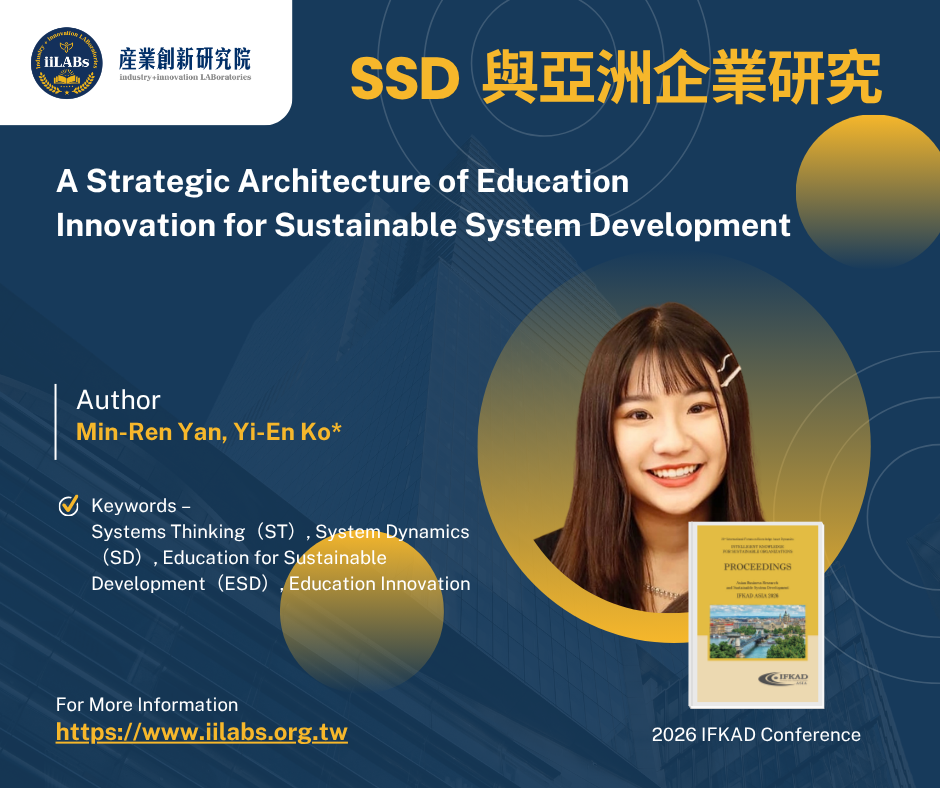
A Strategic Architecture of Education Innovation for Sustainable System Development
📙刊登處:2026 IFKAD國際學術研討會
📙作者姓名: Min-Ren Yan, Yi-En Ko
論文摘要:
In response to increasingly complex social, economic, and environmental challenges, Education for Sustainable Development (ESD), promoted by the United Nations, has become a key direction for global educational transformation. ESD emphasizes the development of learners’ systems thinking and value-oriented action competencies. However, in practice, ESD tends to focus on conceptual advocacy, while lacking a systematic framework grounded in scientific methods for evaluating learning outcomes.
This study is grounded in System Dynamics (SD) education and integrates the core values of ESD to propose an innovative model termed Education for Sustainable System Development (SSD). The theoretical framework is based on the K–12 system dynamics integration model proposed by the System Dynamics Society (SDS), and incorporates ten strategic dimensions (S1–S10), including teacher training, policy support, professional learning communities, curriculum design, NGO collaboration, and international networking.
The study adopts a mixed-methods approach, combining literature analysis and semi-structured interviews. The United States, Türkiye, and the United Nations are selected as case study subjects. In addition, in-service K–12 teachers in Taiwan are interviewed to explore the feasibility and potential impacts of implementing the SSD model in real educational contexts. Furthermore, a system dynamics model is constructed using computer-based simulation tools to examine the projected effects of different strategies within Taiwan’s education system.
This study clarifies the core concepts and educational values of the SSD model, and analyzes how Western countries institutionalize such approaches through higher education, research-driven initiatives, and professional networks. By synthesizing international benchmark cases and Taiwan’s current development context, the study proposes a strategic framework for promoting SSD as an educational innovation model that integrates global perspectives with local applicability. Finally, practical recommendations are provided regarding policy design, teacher training pathways, and cross-sector collaboration. The study aims to support Taiwanese educational institutions in embedding sustainability into systematic curricula, fostering public trust in educational quality, advancing systems literacy under national education policies, and providing an empirical foundation for future development.