
📙論文名稱:
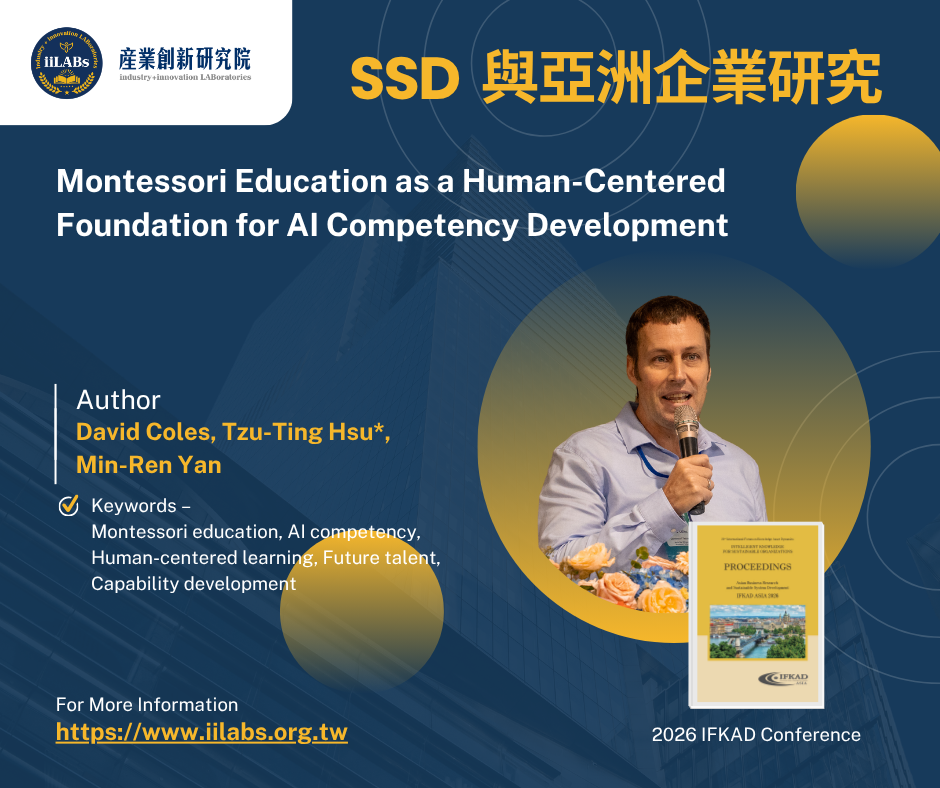
Montessori Education as a Human-Centered Foundation for AI Competency Development
📙刊登處:2026 IFKAD國際學術研討會
📙作者姓名: David Coles, Tzu-Ting Hsu, Min-Ren Yan
論文摘要:
The rapid integration of artificial intelligence (AI) into organizational systems is reshaping how knowledge is created, interpreted, and applied. As AI increasingly automates routine and analytical work, sustainable competitive advantage is shifting toward distinctly human capabilities. In AI-mediated environments, key competencies now include abstraction and systems thinking, problem framing, adaptive learning, ethical judgment, and collaborative intelligence (Brynjolfsson and McAfee, 2014). These capabilities influence how effectively individuals interact with intelligent systems and contribute to hybrid human–machine knowledge processes.
From a knowledge management perspective, this transformation raises an important question: what kind of educational foundation prepares individuals for AI-driven organizational environments? While much discussion of AI competence focuses on technical literacy, long-term organizational effectiveness depends on deeper human capacities. Abstraction, reflective reasoning, ethical awareness, and collaborative problem solving are not developed suddenly in adulthood. They emerge through earlier developmental experiences.
This paper proposes the Montessori–AI Capability Alignment Framework (MACAF), a three-layer conceptual model explaining how Montessori pedagogy functions as a developmental foundation for AI-era organizational competencies.
Layer 1 – Developmental Design Mechanisms
The first layer identifies structural design features embedded within Montessori education. Rather than focusing primarily on content transmission, Montessori environments are intentionally designed to shape how knowledge is formed.A sequenced progression from concrete experience to abstract representation enables learners to internalize logical and mathematical relationships. For example, children explore number concepts through physical materials such as beads and rods before transitioning to symbolic reasoning. This approach, rooted in the work of Maria Montessori, supports deep conceptual understanding rather than procedural memorization.Extended, uninterrupted work cycles give learners time to plan, focus, and sustain attention. Students take responsibility for their work and develop persistence when facing challenges. Self-correcting materials transform error into immediate feedback, normalizing revision and encouraging iterative learning.Mixed-age classrooms foster peer teaching, observation, and shared responsibility. Older students explain ideas and model advanced work, while younger students observe and gradually participate. Teachers act primarily as observers and guides, intervening strategically rather than directing every task. Together, these design elements form a developmental system that shapes cognition, motivation, and social responsibility over time.
Layer 2 – Human Cognitive and Behavioral Capacities
The second layer examines the human capacities that emerge from these mechanisms. Learners develop structural abstraction and the ability to recognize patterns and relationships across domains. They become increasingly capable of transferring knowledge from one context to another. Sustained engagement in self-directed work supports problem ownership and intrinsic motivation. Students learn to define goals, manage time, and persist. The normalization of feedback encourages iterative thinking. Students test ideas, revise their work, and adapt strategies based on new information. The teacher-as-guide model strengthens metacognitive awareness. Students reflect on their thinking, monitor progress, and adjust approaches. Participation in mixed-age communities develops collaborative intelligence, ethical awareness, and perspective-taking. Students practice negotiation, conflict resolution, and shared responsibility. These capacities are interconnected and transferable. Together, they form a flexible foundation for navigating complex and evolving knowledge environments.
Layer 3 – AI-Era Organizational Competencies
As knowledge processes become increasingly mediated by AI, these human capacities take on new operational significance.Structural abstraction supports systems literacy and algorithmic interpretation. Individuals who understand relationships and structures are better able to interpret AI outputs and recognize limitations.Problem ownership improves human–AI task framing. The quality of AI-generated responses depends strongly on how clearly individuals define goals and constraints.Iterative reasoning supports the refinement cycles typical of AI-assisted workflows. Users generate outputs, evaluate results, adjust prompts, and improve solutions.Metacognitive awareness strengthens responsible and ethical AI use. Individuals can question reliability, detect bias, and evaluate consequences.Collaborative intelligence enables coordination in hybrid human–AI teams that require communication, negotiation, and shared understanding.In this way, the capacities cultivated through Montessori developmental design evolve into competencies relevant in AI-mediated organizational contexts. AI readiness therefore reflects earlier cognitive and socio-ethical formation rather than technical training alone.
Institutional Case Study: North Star Bilingual Montessori School
To demonstrate practical alignment, this paper examines North Star Bilingual Montessori School as an institutional example. The school embeds structured independence, bilingual communication, and reflective inquiry within its curriculum. Students regularly engage in complex, multi-stage projects connected to real-world issues. For example, after studying ecosystems and environmental interdependence, students may initiate a beach-cleaning project. Inspired by their research, they contact environmental protection organizations to request guidance and materials, plan transport and safety procedures, research the most appropriate locations and times, and communicate with community stakeholders. They also collect and analyze data on waste, reflect on ecological impact, and present their findings. Through this process, students integrate scientific understanding, collaboration, ethical responsibility, and practical problem solving. Such experiences provide a longitudinal view of how Montessori environments cultivate socio-cognitive resilience, adaptability, and initiative. This case illustrates that readiness for AI-mediated work develops through structured independence, responsibility, and reflective engagement from an early age.
Conclusion and Theoretical Contribution
The MACAF framework contributes to knowledge management by linking early developmental pedagogy with organizational capability research. Scholars such as Ikujiro Nonaka and Takeuchi (1995) have examined how organizations create and leverage knowledge. However, less attention has been given to the developmental origins of the cognitive and ethical capacities that sustain these processes. By articulating alignment between Montessori design mechanisms and AI-era competencies, this framework extends capability-based perspectives to earlier stages of human development. The example of North Star Bilingual Montessori School further demonstrates its applied relevance. This perspective suggests that sustainable organizational performance in the AI era depends not only on technology, but on human-centered educational systems that cultivate abstraction, responsibility, adaptability, collaboration, and ethical awareness from childhood.